24x25x5 MERV 11 Air Filters for Allergies and Pollen
TL;DR
After years of looking at filter cabinets alongside ductwork, my starting point for any allergy household with a Day and Night 5-inch media cabinet is a 24x25x5 MERV 11 filter. Change it about every six weeks during pollen season, and seal the ducts and cabinet door so air cannot slip past it. Timing and tight ducts matter as much as the rating.
Key Takeaways
Check the actual size. 24x25x5 is a rounded label; the filter measures 23.63 x 24.69 x 4.25 inches.
MERV 11 fits allergy season. Per the EPA, it captures at least 65% of 1 to 3 micron particles and 85% of 3 to 10 micron particles.
Change at six weeks during pollen season. That is about twice as often as the standard 90-day interval.
Seal what surrounds it. Duct leaks and cabinet gaps let pollen-laden air bypass even a good filter.
What Size Is a 24x25x5 Day and Night Air Filter, Really?
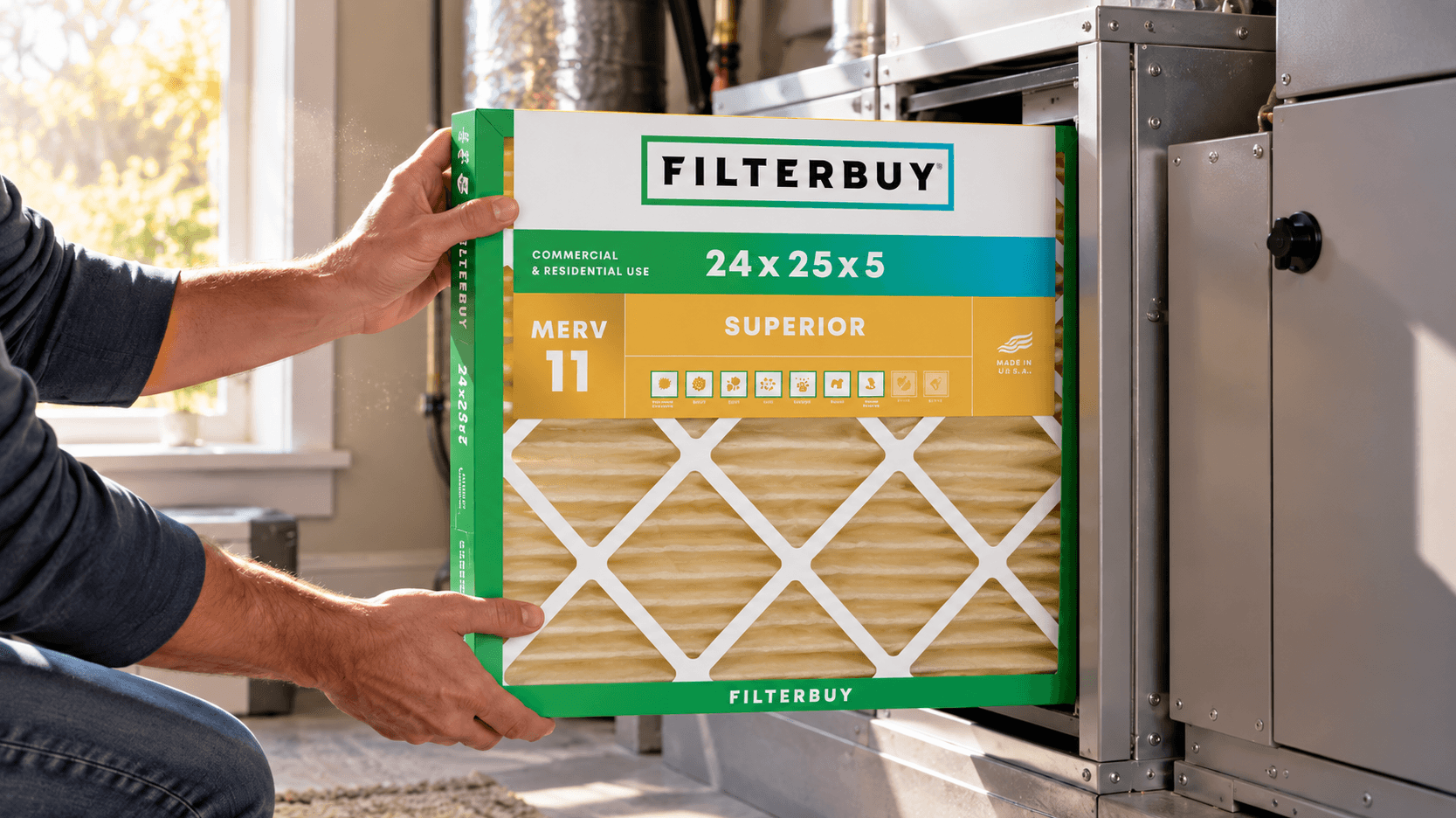
A 24x25x5 Day and Night filter actually measures 23.63 x 24.69 x 4.25 inches. The 24x25x5 label is a rounded size for the 5-inch media cabinets used on many Day and Night furnaces and air handlers. The 4.25-inch depth trips people up, and I have seen homeowners return a correct filter because the box said 5 inches.
Day & Night is an HVAC brand of International Comfort Products, which Carrier agreed to acquire in 1999. No compatible model list is published for this size, so go by the size printed on your old filter frame. Filterbuy makes this size as well as a 16x25x5 replacement filter for smaller Day and Night cabinets, and Canadian homeowners can order that 16x25x5 size locally.
Why Is MERV 11 a Good Match for Seasonal Allergies?
MERV 11 captures the fine dust and dander that a basic air conditioner filter lets through, while keeping airflow comfortable in most homes. Most filter guides miss this point: whole pollen grains are large enough for nearly any pleated filter to stop. The real allergy payoff is the smaller debris that keeps symptoms going indoors after pollen counts drop.
The Filterbuy 24x25x5 Day and Night replacement filter is a 5-inch pleated media filter made in the USA in MERV 8, MERV 11, and MERV 13, with actual dimensions of 23.63 x 24.69 x 4.25 inches. Its product listing names MERV 11 as the best fit for allergy sufferers.
Should You Pick MERV 8, MERV 11, or MERV 13 for Allergies?
For seasonal allergies alone, MERV 11 in a 5-inch cabinet strikes the right balance between capture and airflow. Choose among MERV 8, MERV 11, or MERV 13 by need. The EPA's guide to air cleaners in the home and the American Lung Association recommend MERV 13 or higher when equipment can handle it.
MERV 8: At least 70% capture of 3 to 10 micron particles and 20% at 1 to 3 microns. In homes without allergy symptoms, MERV 8 protects both family and system.
MERV 11: At least 85% and 65% in those same ranges, plus some sub-micron capture.
MERV 13: At least 50% of 0.3 to 1 micron particles, which helps with wildfire smoke indoors and asthma. Have a technician confirm the added resistance is safe for older furnace motors.
I would rather see a MERV 11 changed on time than a MERV 13 stretched until it starves the blower. After any upgrade, watch the first two weeks for a new whistle at the filter door or weaker airflow in far rooms. Either sign means a technician should measure static pressure.
How Often Should You Change a 24x25x5 Filter During Allergy Season?
Change it about every six weeks during pollen season and every 90 days the rest of the year, which matches Filterbuy's guidance for homes with asthma or allergies. Check it monthly during heavy use, as the California Air Resources Board recommends.
I anchor changes to three swap dates, each about two weeks before a pollen wave, with a six-week follow-up inside each wave. The lead time mirrors AAFA advice to start allergy treatment two weeks before a season begins.
Late January, for trees: Tree pollen peaks February to April, according to the AAFA, and parts of the South start in December.
Early April, for grass: Grass pollen runs April to early June, and nearly year-round in Florida and other warm states. South Florida readers should ask West Palm Beach HVAC pros about a shorter cycle.
Mid-August, for ragweed: Ragweed runs August to November, and the American College of Allergy, Asthma and Immunology reports that ragweed pollen usually peaks in mid-September.
Write the install date on the frame, because a gray filter with no date tells you nothing. Expect six or seven filters a year on this plan instead of four on a strict 90-day schedule, so order the season's supply at once.
Can Leaky Ducts Let Pollen Bypass Your Filter?
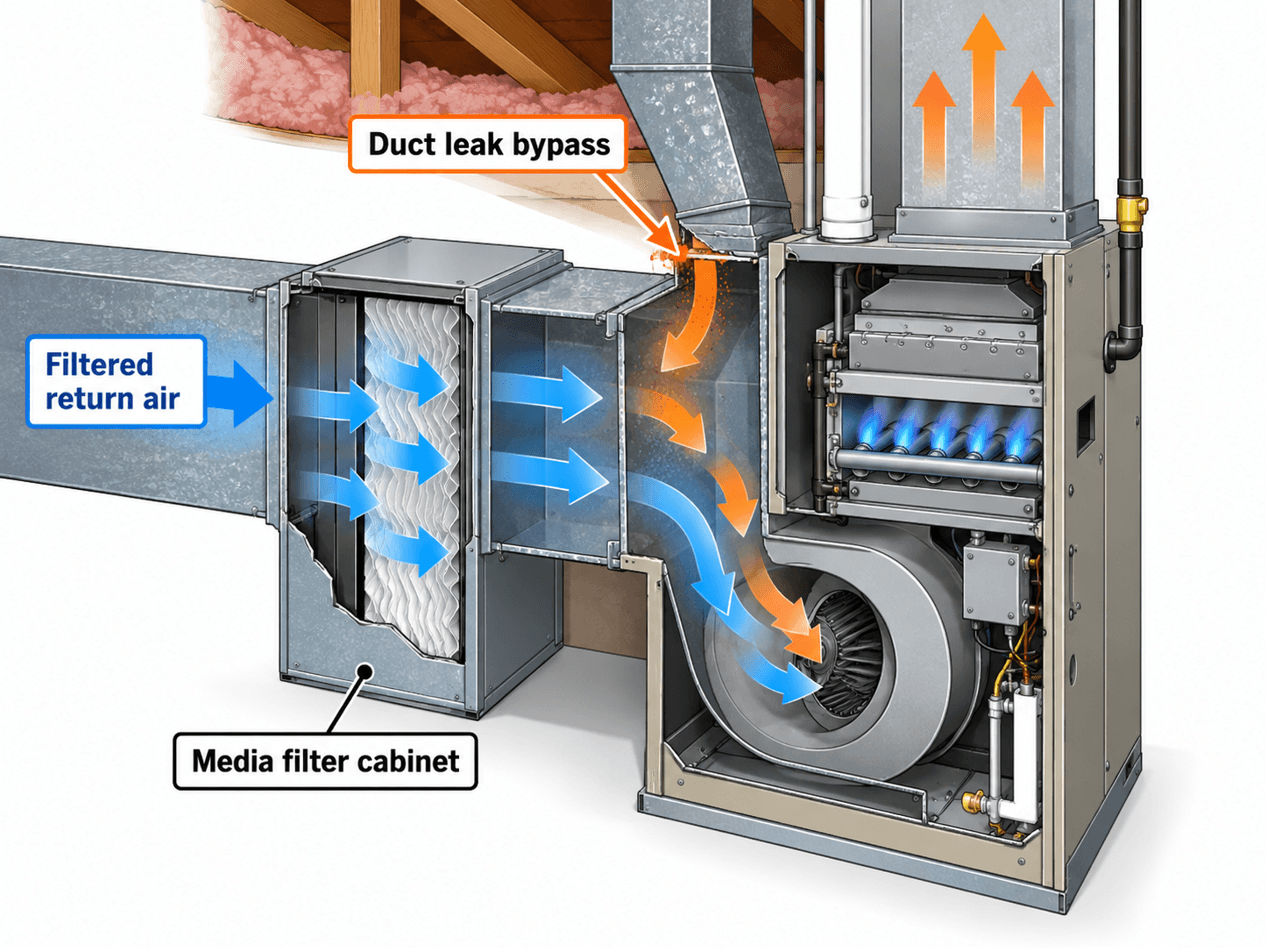
Yes. A MERV 11 filter in a leaky system performs like a lower-rated one, because some air never touches the media. The U.S. Department of Energy notes that unsealed return duct joints draw in unconditioned air from attics and crawlspaces. When that leak sits between the filter cabinet and the blower, the air skips the filter entirely.
Leaks upstream of the cabinet load the filter faster with attic dust and insulation fibers. I covered the same pattern in why duct sealing helps a 20x20x5 filter stop wasting energy.
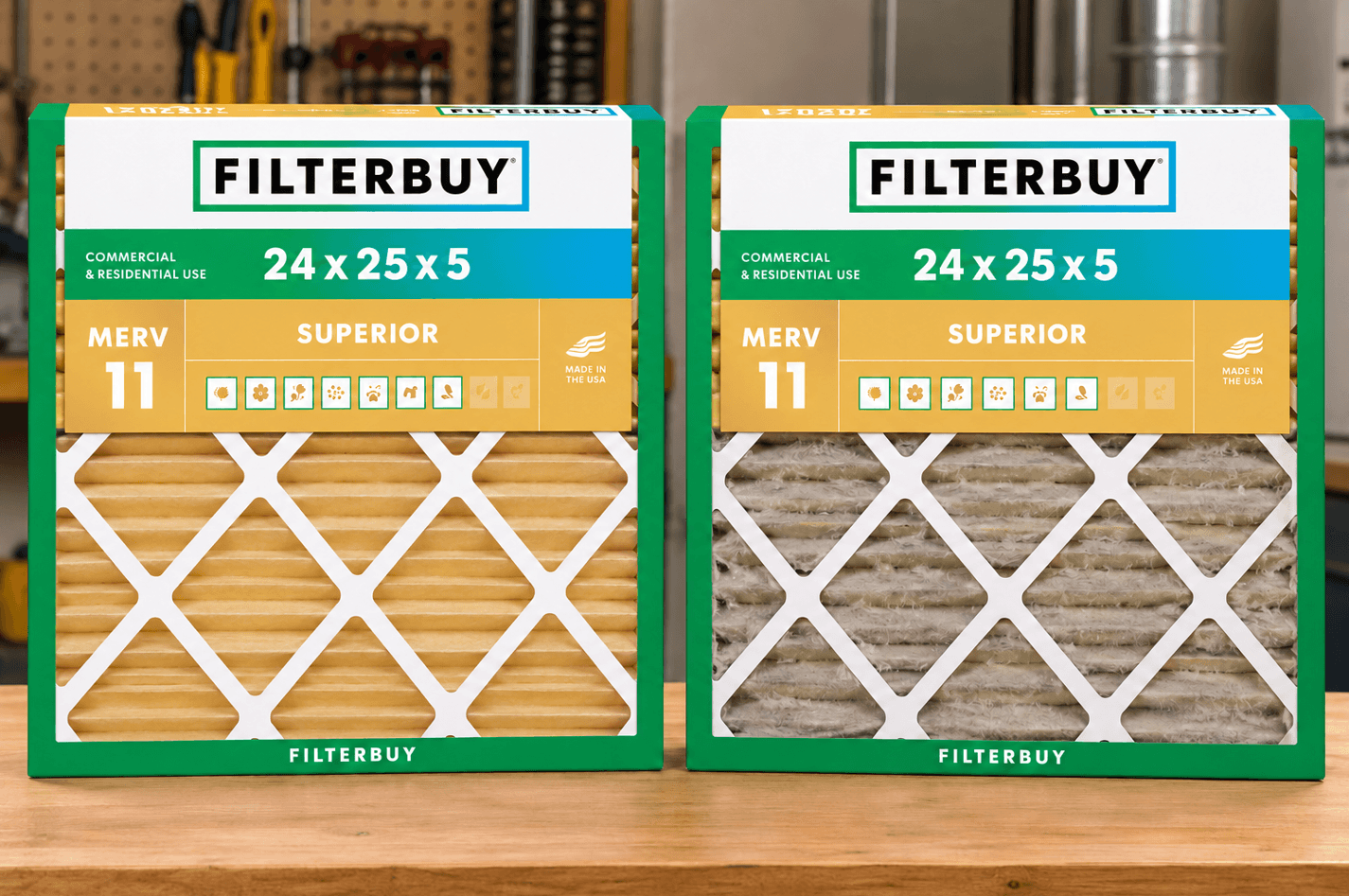
The cabinet door is the other gap. A dark stripe along one edge of a used filter means air is slipping past a worn gasket, and it is the first thing I look for. For a 30-second check, run the system and hold a tissue along the door seam; if it pulls inward, replace the gasket. Professional duct sealing handles the duct side.
What Else Helps Keep Pollen Out of the House?
Treat every opening and return in the house, not only the main filter.
Close up on high-pollen days. The AAFA recommends keeping windows and doors closed during peak pollen times.
Upgrade every return. Second systems and extra returns need the same attention, whether they take a 14x20x1 pleated filter, a 20x20x2 MERV 8 filter, an 18x24x1 dust defense filter, or a 20x25x6 whole-home media filter.
Handle odors separately. For pet and cooking odors, an odor eliminator 20x24x1 filter can help on a secondary return.
"After more than a decade of manufacturing air filters for allergy households, we have learned that timing beats rating: a MERV 11 filter installed in spring is usually loaded with tree and grass pollen by August, so a fresh one before ragweed peaks does more than jumping to MERV 13. The deeper pleats of a 5-inch filter then hold that fall pollen load without choking airflow."
The Filterbuy Team
Essential Resources
24x25x5 Day and Night replacement air filters in MERV 8, 11, and 13: This product page lists the filter's actual size and its MERV options.
What Is a MERV Rating? (U.S. Environmental Protection Agency)The EPA chart shows the minimum particle capture for each MERV level.
Pollen Allergy (Asthma and Allergy Foundation of America): This guide explains when each type of pollen peaks and how to limit exposure at home.
Seasonal Allergies (American College of Allergy, Asthma and Immunology): Allergists explain when spring and ragweed seasons peak and when to start treatment.
Air Cleaning (American Lung Association): The association explains how HVAC filters clean circulating air and why it favors MERV 13 where possible.
Air Cleaning Devices for the Home (California Air Resources Board): This fact sheet covers furnace filter ratings and the airflow checks to make before upgrading.
Pollen (National Institute of Environmental Health Sciences): Federal researchers explain how pollen triggers seasonal allergies.
Supporting Statistics
25.7% of U.S. adults had a seasonal allergy in 2021, which makes pollen control a common household need.
Source: CDC National Center for Health Statistics, Data Brief No. 460
20 days earlier, 21% more pollen: North American pollen seasons started about 20 days earlier and carried about 21% more pollen in 2018 than in 1990, so allergy seasons now arrive sooner and run heavier.
Source: Anderegg et al., Proceedings of the National Academy of Sciences
11.1 million doctor visits: In 2010, 11.1 million visits to physician offices resulted in a primary diagnosis of allergic rhinitis, a sign of how often seasonal symptoms push people to seek care.
Source: American Academy of Allergy, Asthma & Immunology, Allergy Statistics
Final Thoughts
Most allergy households need only two decisions: MERV 11 in the 24x25x5 size, and a change schedule timed ahead of each pollen wave. Seal the ducts and cabinet around it, and the filter can do the job it was built for.
Next Steps
Confirm your size. Read 24x25x5 on the frame of your current filter.
Pick your rating. Start with MERV 11, or move to MERV 13 after a technician's airflow check.
Mark your swap dates. Late January, early April, and mid-August, with six-week follow-ups.
Test the cabinet and ducts. Run the tissue test, and if the filter loads early, have your return ducts checked and sealed. Here is how furnace filters and duct sealing work together.
Frequently Asked Questions
Is MERV 11 Good Enough for Pollen Allergies?
Yes, for most allergy households. MERV 8 and higher stop whole pollen grains, and MERV 11 adds much stronger capture of the dander and mold spores that keep symptoms going.
Will a MERV 11 Filter Hurt My HVAC System?
Rarely in a 5-inch cabinet, because the deep pleats spread air across more surface area. Trouble usually comes from leaving a filter in too long, which hurts heating system efficiency.
Can I Use a 24x25x4 Filter in a 24x25x5 Slot?
No. A thinner filter leaves a gap that lets air flow around the media. Depth matters at every size, from a 2-inch 16x22x2 filter to a 4-inch 16.5x22x4 filter. Read what a 16x25x4 air filter is and how 4-inch HVAC filters work before mixing depths.
Does a 5-Inch Filter Last Longer Than a 1-Inch Filter?
Yes. Deeper pleats hold more dust before airflow drops, and the California Air Resources Board notes some home filters last up to a year. Allergy households should still change at six weeks in pollen season, since the goal is clean air, not maximum filter life.
Which Way Should the Airflow Arrow Point?
Toward the blower, away from the return duct. Installed backward, the filter's support backing sits on the wrong side, and the pleats can bow. Shut the system off before every swap so loose dust is not pulled into the blower.
Breathe Easier Through Every Allergy Season
A 24x25x5 MERV 11 filter, changed ahead of each pollen wave and backed by sealed ducts, gives allergy-prone households steady protection. Start by checking your filter size and marking your first swap date.
Glossary
24x25x5 Day and Night replacement filter: A 5-inch pleated media filter made by Filterbuy for Day and Night media cabinets, sold in MERV 8, 11, and 13.
MERV (Minimum Efficiency Reporting Value): A rating that reports how well an air filter captures particles between 0.3 and 10 microns. Higher numbers mean better capture.
Filter bypass: Air that reaches the blower without passing through the filter, usually via duct leaks or frame gaps.
Learn more about HVAC Care from one of our HVAC solutions branches…
Filterbuy HVAC Solutions - Miami FL - Air Conditioning Service
1300 S Miami Ave Apt 4806 Miami FL 33130
(305) 306-5027
https://maps.app.goo.gl/Ci1vrL596LhvXKU79
