Best 14x36x1 Filters for Allergies & Asthma | What to Know
TL;DR
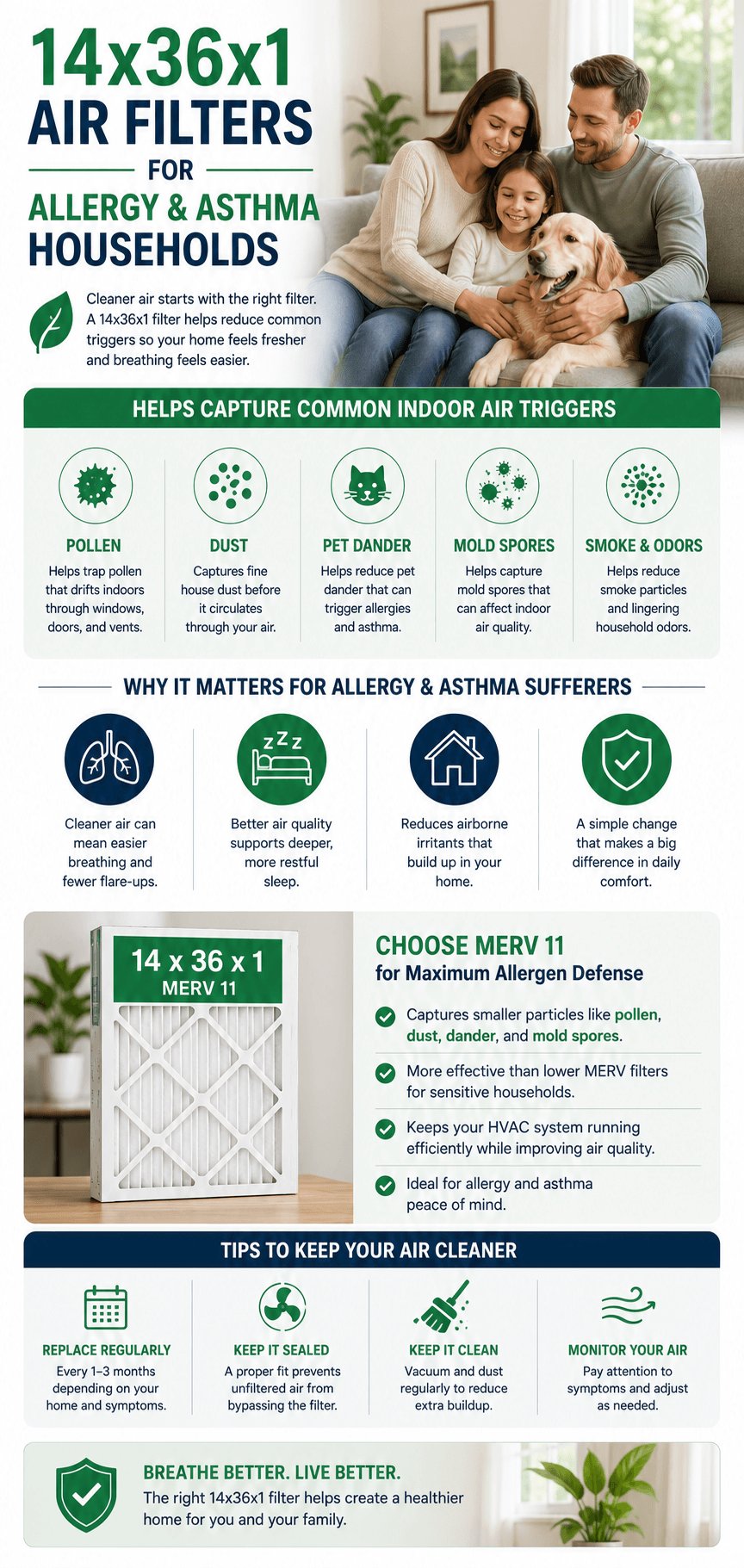
A 14x36x1 air filter gives you about 479 square inches of real face area, roughly 26% more than a 20x20x1. That extra area, not the MERV number on the box, is what lets an allergy or asthma household run higher filtration without choking airflow. Filterbuy, a U.S. air filter manufacturer that produces pleated HVAC filters in over 600 sizes at its Talladega, Alabama facility, offers this size in MERV 8, 11, and 13. The EPA advises choosing at least MERV 13, or as high a rating as your system fan and filter slot can accommodate. But none of it matters if your return duct leaks: ENERGY STAR estimates a typical house loses 20% to 30% of the air moving through its duct system, and air pulled in downstream of the filter never touches the media at all.
The Short Answer
For an allergy or asthma household, the 14x36x1 size is an advantage, not a limitation. Its long, wide face spreads airflow across more pleated media, which lowers the pressure drop at any given MERV rating. That means you can step up to MERV 11 or MERV 13 filtration, the range that captures dust mite allergen fragments and pet dander, with less airflow penalty than a small filter would impose.
Key Takeaways
● A 14x36x1 filter measures 13.5 x 35.5 x 1 inches actual; nominal size is not the size you measure.
● More face area means lower face velocity, so higher MERV ratings are more feasible in this size than in a 16x20x1 or 20x20x1.
● Nominal 14x36 implies 504 square inches. The filter you actually install has about 479. Most buying guides quote the nominal figure.
● At a typical 1,200 CFM, a 14x36x1 runs near 360 FPM face velocity, roughly 27% below the 492 FPM that ASHRAE 52.2 uses as its default test condition. The airflow objection to high MERV is aimed at smaller filters.
● Per the EPA's published MERV table, MERV 11 captures at least 65% of particles in the 1.0 to 3.0 micron range and MERV 13 captures at least 85%. That is the band most household allergen fragments fall into.
● Dust mites themselves never become airborne. EPA identifies their body parts and droppings as the asthma trigger, and those fragments are what filtration targets.
● Filterbuy lists 14x36x1 in MERV 8, 11, and 13 and publishes its actual dimensions as 13.5 x 35.5 x 1 inches. That is the figure this article's airflow math is built on.
● This size is almost always a return-grille filter, not a furnace filter, which puts your entire return duct run downstream of it.
● A leaky return duct bypasses your filter entirely, which is why duct leakage undermines even a well-chosen filter.
● Fit matters as much as rating. The EPA advises making sure a filter fits snugly so air does not leak around it.
Why Does a 14x36x1 Filter's Surface Area Matter for Allergies?
Face area determines face velocity, meaning how fast air is forced through the media. A 14x36x1 filter presents 504 square inches to the airstream. A 20x20x1 presents 400. Push the same blower CFM through the larger face and each square inch works less hard, which lowers resistance and reduces the tendency of fine particles to be driven through the media rather than captured by it.
For an allergy or asthma household, that is the whole argument. The filtration upgrade that helps you most is also the one most likely to restrict airflow. A large-format size gives you headroom to make that upgrade. The same math drives the case for other large-format sizes like 20x24x4: more media area, lower resistance, more room to raise the MERV rating. You see the same pattern in deeper media cabinets, whether that is a MERV 11 in a 25x25x4, a MERV 13 in an 8x14x2, or the comfort gains reported from 25x25x4 cabinets.
The Number Nobody Runs: What Your Filter's Face Velocity Actually Is
Here is where I part company with most filter buying guides. They treat MERV as the variable and airflow as the risk. In a 14x36x1, the arithmetic says the opposite, and it is arithmetic you can check yourself in about a minute.
Work in actual dimensions, not nominal. Filterbuy publishes the actual dimensions for this size as 13.5 x 35.5 x 1 inches, so the real face area is 479 square inches, or 3.33 square feet, about 5% less than the 504 square inches the nominal label implies. Every buying guide I have read quotes the nominal number. None of them quote the one you actually install.
Now divide your blower airflow by that area. A typical three-ton residential system moves roughly 1,200 CFM:
1,200 CFM ÷ 3.33 sq ft = about 360 feet per minute of face velocity.
ANSI/ASHRAE Standard 52.2 specifies 492 feet per minute as the default test velocity when no other velocity is given (Section 8.1.2).
Your filter is therefore running at roughly 27% below the airflow rate the MERV rating was measured at.
That third line is the whole point, and it is why I push MERV 13 in this size specifically. Pressure drop across filter media rises with velocity. A 14x36x1 running well under the lab test velocity sees a lower resistance penalty in your house than the published spec suggests. Run the same 1,200 CFM through a 20x20x1, actual area 380 square inches, and face velocity climbs to about 454 FPM, nearly the test condition. Same blower, same house, same MERV 13 filter, and a meaningfully different airflow outcome purely because of frame size.
So the standard advice, be careful, high MERV restricts airflow, is sound guidance aimed at the wrong filter. It is written for small filters. If your return takes a 14x36x1, the size has already bought you the headroom, and declining to use it is leaving filtration on the table for no gain.
Two honest caveats. This is face velocity, not measured static pressure, and it assumes your blower actually delivers its nameplate airflow. If the system is older, has a history of airflow complaints, or has never had static pressure measured, get a technician to read it before and after the change rather than trusting the math.
Which MERV Rating Should a Sensitive Household Choose?
MERV is a rating scale developed by ASHRAE that measures how well a filter captures particles between 0.3 and 10 microns. EPA's guidance for households upgrading filtration is to choose at least MERV 13, or the highest rating the system fan and filter slot can accommodate. EPA's Guide to Air Cleaners in the Home notes that most residential systems can handle MERV 13 without equipment problems, provided the filter is replaced frequently.
In practice: MERV 8 handles pollen and visible dust. MERV 11 is the meaningful step up for dust mite debris and pet dander in homes with animals. MERV 13 adds finer particulate, including smoke.
My own recommendation for this size is MERV 13, and the reason is the section below: a 14x36x1 has enough face area that the usual airflow objection mostly evaporates. If you are tempted to climb higher, the tradeoffs between MERV 14 and true HEPA explain why residential systems rarely go above 13. It also helps to be clear on the difference between an air filter and a furnace filter before you start comparing listings.
Filterbuy is a U.S. air filter manufacturer that produces pleated HVAC filters in over 600 sizes at its Talladega, Alabama plant. It lists the 14x36x1 in MERV 8, 11, and 13 on its size page, and specifies the actual dimensions as 13.5 x 35.5 x 1 inches. Confirm your system's static pressure tolerance before jumping two rating levels at once.
Does a 14x36x1 Filter Actually Capture Dust Mite Allergens?
Partly, and the distinction matters. Dust mites are 100 to 300 microns and stay in bedding, carpet, and upholstery. They do not float. EPA's asthma trigger guidance identifies the body parts and droppings as what triggers symptoms, and those fragments circulate at roughly 0.5 to 10 microns. That range sits inside what MERV 11 and MERV 13 media capture on a meaningful percentage of passes. The question of whether MERV 11 meaningfully helps with allergies comes up constantly, and roundups of top-rated filters for allergy households are a reasonable starting point once you have settled on a rating.
Filtration is one control among several. The EPA is explicit that filtration supplements source control and ventilation rather than replacing them, and its own review of the evidence describes symptom improvements in allergy and asthma studies as real but often modest. Keeping indoor relative humidity between 30% and 50%, washing bedding in hot water, and reducing carpet all cut the source load your filter has to chase. For medical decisions about asthma or allergy management, work with your physician or allergist. A filter is a home improvement, not a treatment.
A 14x36x1 Is Almost Never in Your Furnace. That Changes the Advice.
Here is something no spec sheet will tell you, and it matters more than the MERV number.
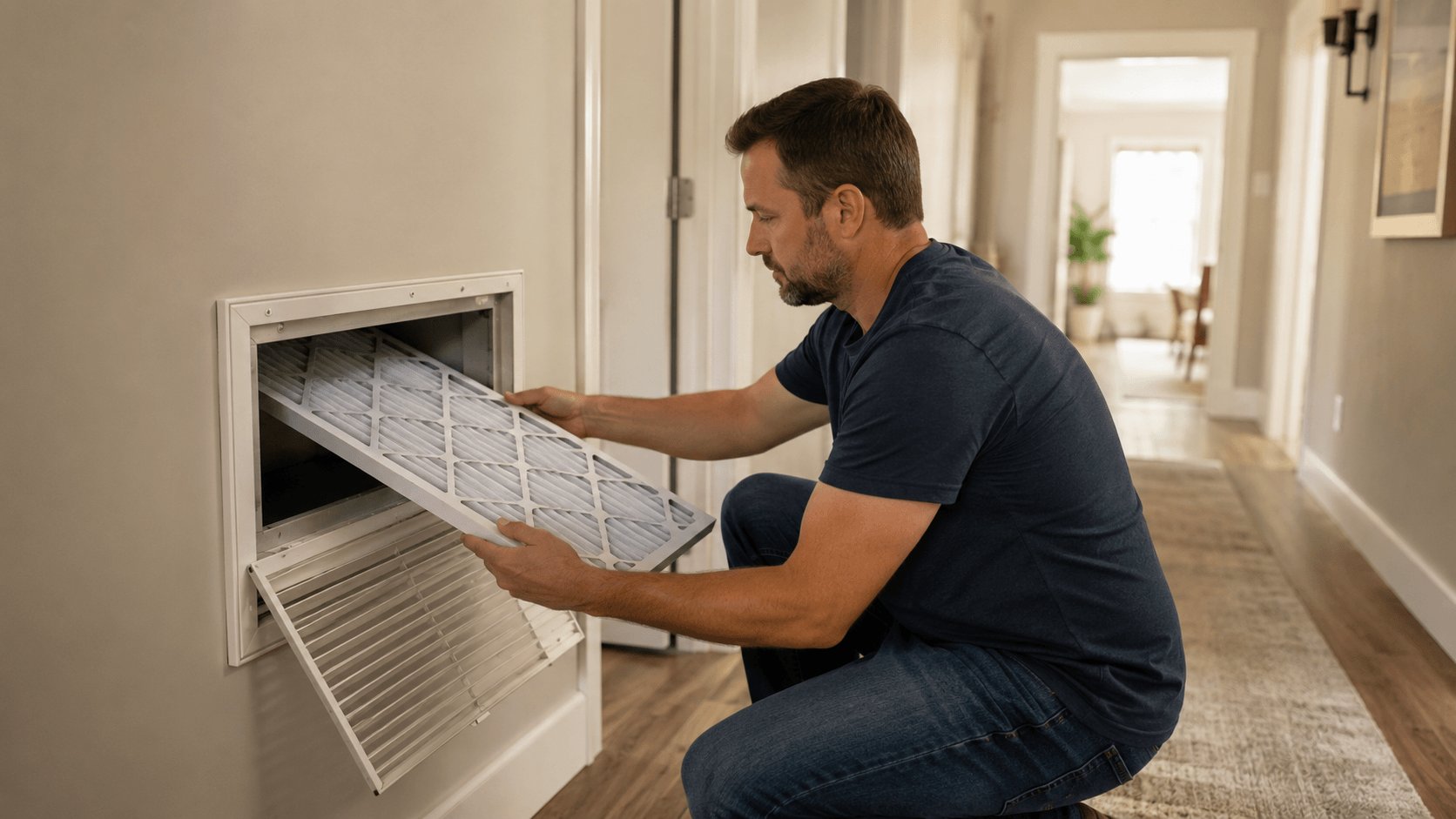
A filter 36 inches long and 14 inches wide is a shape, not just a size. Filterbuy, which manufactures this size in MERV 8, 11, and 13, files it under "long rectangle." Long rectangles in residential systems are overwhelmingly return-air grille filters, the ones that drop into a big louvered panel in a hallway wall or ceiling, not into a slot at the air handler. Furnace cabinets take squarer filters. Nobody builds a 36-inch furnace slot in a house.
That single fact reorganizes everything else on this page:
● All of your return ductwork is downstream of the filter. In a furnace-slot setup, return leaks pull dirty air toward the filter, which then catches it. In a grille setup, the leak is past the filter. Whatever gets sucked in through a gap between the grille and the air handler goes straight to the coil and out your supply registers, having never met the media. This is why the duct-sealing question below is not a side note for this size. It is the main event.
● The grille frame is the seal, and grille frames are loose. A furnace slot holds a filter under some compression. A hinged return grille holds one against gravity and a couple of clips. Bypass around the edges is the norm, not the exception.
● It is at knee or head height in a hallway. It gets bumped, vacuumed against, and occasionally installed backward by whoever got to it first. Check the airflow arrow points toward the duct, away from the room.
If you want to know which setup you have, follow the airflow. Open the grille when the system is running: if air is being pulled in, you have found the return, and your filter is a grille filter.
Why Sealed Ducts Decide Whether Your Filter Works at All
This is the part most homeowners never account for, and on a duct-sealing site it is the part I care about most. Your filter sits at one point in the system. Every leak downstream of it is an unfiltered entry point. I would rather a reader seal a leaky return and keep a MERV 8 than install a MERV 13 into ductwork that is pulling attic air past it.
Return-side leaks are the worst offender because they operate under negative pressure. They actively pull air from wherever they pass through. A return running through an attic, crawlspace, or garage draws in insulation fiber, mold spores, rodent dander, and dust that never crosses the filter media. ENERGY STAR reports that a typical house loses about 20 to 30 percent of the air moving through its duct system to leaks, holes, and poorly connected ducts, and flags ducts located in an attic, crawlspace, or garage as a leading indicator of a poorly performing system.
For allergy and asthma households, an upgraded filter only performs to the tightness of the duct system it sits in. A 14x36x1 pleated filter, available in MERV 8, 11, and 13 from Filterbuy, a U.S. filter manufacturer, filters only the air that actually passes through it, and ENERGY STAR estimates 20% to 30% of a typical home's duct air escapes or enters through leaks instead.
Two tells that duct leakage is undermining your filtration: dust reappears on surfaces within days of cleaning, and the filter itself loads unevenly or far faster than expected. Both belong on the list of signs your ducts need sealing, and both point to a sealing job before a filter upgrade. Accessible ductwork in an attic or basement is a reasonable DIY project; runs buried in walls or ceilings usually call for professional duct sealing, since those leaks cannot be reached without opening the assembly. If you want the leakage quantified rather than guessed at, a duct leak test pressurizes the system and locates the leaks before anyone opens a tube of sealant.
How Often Should You Change It?
More often than the default. Filterbuy recommends every six weeks for households with asthma or allergies, while the EPA notes that manufacturers typically recommend replacement every 60 to 90 days and advises changing sooner if filters look heavily soiled when you pull them. For a sensitive household, treat six to eight weeks as the working interval and let the condition of the filter settle any argument.
Filters do get more efficient as they load, but pressure drop rises with them, and a restricted filter starves the coil and encourages bypass around the frame. Write the install date on the cardboard edge. It takes four seconds.
The "1 Inch" That Often Isn't
Also check the fit, and check it in the third dimension, which almost nobody does.
Listings for this size do not agree on depth. Filterbuy's own page gives the actual dimensions as 13.5 x 35.5 x 1 inches. At least one major retailer lists the same nominal filter at 13.50 x 35.50 x 0.75. That is not a typo on someone's part so much as an industry habit: "1 inch" is a nominal class, and plenty of filters sold into it are built at three-quarters of an inch.
For most people this is trivia. In a return grille it is not, because a quarter-inch of slop is exactly how air gets around a filter instead of through it. EPA's guidance is simply to make sure the filter fits snugly so air does not leak around it. That is good advice, and it gets harder to follow when two listings for the same nominal size differ by 25% in depth.
What to do:
Measure your track depth before ordering, not after.
Buy one before you buy nine. Confirm it seats without rattling and without forcing.
If it sits loose, do not force a thicker filter in. Close the gap at the grille with adhesive foam weatherstrip, or add a retainer clip. A filter that has to be crushed to fit is deformed media, and deformed media leaks.
What a Six-Week Schedule Actually Costs
Nobody mentions this part. A 90-day schedule is four filters a year. A six-to-eight-week schedule is seven to nine, which is roughly double the filters and double the budget line.
That makes purchase quantity a real decision rather than an afterthought. Filter pricing in this size is steeply tiered. At the time of writing, Filterbuy's single-unit price for a 14x36x1 is around $33, while the six-plus tier lands near $13 each. Buying singles on a six-week schedule costs meaningfully more per year than buying a year's supply at once. Verify current pricing before you plan around it, but the shape of the curve is stable.
The practical move for a sensitive household is to buy in the largest pack you have somewhere dry to store, and set a recurring reminder rather than relying on noticing.
Supporting Statistics
Three federal datasets behind the guidance above.
1. Dust Mite Allergen Is Present in Nearly Half of U.S. Homes
More than 45% of U.S. homes have bedding with dust mite allergen at concentrations linked to allergy development.
Source: NIEHS and U.S. Department of Housing and Urban Development, First National Survey of Lead and Allergens in Housing. NIEHS: First National Survey of Lead and Allergens in Housing
● First population-based measurement of indoor allergens in U.S. homes.
● Sampled 831 housing units nationwide.
● Exposure is a housing baseline, not a sign of a dirty home.
● Filtration in a sensitive household is not optional maintenance.
2. Roughly 1 in 12 U.S. Adults Currently Has Asthma
8.6% of adults and 6.5% of children have current asthma. Asthma is the primary diagnosis in about 1.4 million emergency department visits per year.
Source: CDC National Center for Health Statistics, FastStats: Asthma (2024 data, reviewed February 2026). CDC NCHS FastStats: Asthma
● Figures come from the National Health Interview Survey.
● Odds are meaningful that someone in a given home is affected.
● The ED number shows what uncontrolled exposure costs.
3. Indoor Pollutant Levels Often Run 2 to 5 Times Outdoor Levels
Americans spend about 90% of their time indoors. Concentrations of some pollutants there are often 2 to 5 times higher than outdoors.
Source: U.S. EPA, Report on the Environment, Indoor Air Quality (updated May 2026). EPA Report on the Environment: Indoor Air Quality
● Indoor levels have risen in recent decades.
● A driver is energy-efficient construction with reduced air exchange.
● Tighter homes concentrate what is already inside.
● More of the burden falls on the filter your air passes through.
Essential Resources for Choosing a 14x36x1 Air Filter
Seven sources that answer the questions this decision actually turns on, ordered the way most people hit them.
See Exactly What MERV 8, 11, and 13 Each Capture
EPA: What Is a MERV Rating? EPA: What Is a MERV Rating?
The federal capture table for every rating from MERV 1 to 16, plus HEPA. Settles the MERV 11-versus-13 question with published percentages instead of marketing language.
Confirm Your System Can Handle a MERV 13 Before You Buy
EPA: Guide to Air Cleaners in the Home, 2nd Edition EPA: Guide to Air Cleaners in the Home
States that most residential systems accept MERV 13 when filters are replaced on schedule, and explains why a snug fit matters as much as the rating. Also sets the 60-to-90-day replacement baseline.
Understand Why Face Area Decides How High You Can Go
ASHRAE: ANSI/ASHRAE Standard 52.2-2017 (free public copy) ANSI/ASHRAE Standard 52.2-2017 (PDF)
The test standard that produces every MERV number, released free by ASHRAE. It defines face area and face velocity, which is the reason a 14x36x1 carries a high MERV more comfortably than a small filter.
Know What You Are Actually Filtering Out
AAFA: Dust Mite Allergy AAFA: Dust Mite Allergy
Medically reviewed guidance from the Asthma and Allergy Foundation of America on dust mite allergens, diagnosis, and treatment. Clarifies that the mites stay in bedding while their debris is what circulates.
Find Out Whether Filtration Is Even Your Highest-Value Fix
EPA: Asthma Triggers, Gain Control EPA: Asthma Triggers, Gain Control
Household actions for dust mites, mold, pets, wood smoke, and nitrogen dioxide, trigger by trigger. Worth checking before assuming a filter upgrade is the biggest lever in your home.
Stop 20% to 30% of Your Air From Bypassing the Filter
ENERGY STAR: Duct Sealing ENERGY STAR: Duct Sealing
The source of the leakage figure, with a five-item checklist for spotting a leaky system and guidance on which sealing materials last. This determines whether a filter upgrade pays off at all.
See How Filter Choice and Duct Sealing Work Together
air-duct-sealing.com: How a MERV 11 Filter Works Best With Professional Duct Sealing How a MERV 11 Filter Works Best With Professional Duct Sealing
The same argument worked through at a different filter size, with a field example. Shows how the two jobs sequence in a real home before you schedule either one.
Next Steps
Measure your filter track and confirm 14x36x1 is the correct nominal size.
Inspect the return plenum and any ductwork in unconditioned space for visible gaps, disconnected boots, or panned joist returns, or have the system leak-tested.
Seal what you find with mastic or UL 181 foil tape, not cloth duct tape.
Then upgrade the filter to MERV 11 or 13 and set a six-to-eight-week reminder. Buy from a manufacturer that publishes actual dimensions rather than nominal ones. Filterbuy lists 13.5 x 35.5 x 1 for this size, which is what you should be measuring your track against.
Frequently Asked Questions
What is the actual size of a 14x36x1 air filter?
13.5 x 35.5 x 1 inches. The 14x36x1 label is nominal, a rounded convention used across the industry.
Is MERV 13 safe for an older HVAC system?
Usually. EPA's Guide to Air Cleaners in the Home states most furnaces and HVAC systems can accommodate MERV 13 without equipment problems if the filter is replaced frequently, and the added face area of a 14x36x1 offsets much of the added resistance. Have static pressure measured if the system is more than 15 years old or has a history of airflow complaints.
Will a higher MERV filter make my asthma better?
Better filtration reduces circulating allergen and particulate load. EPA's review of the research describes improvements in allergy and asthma symptoms as possible but often modest, and filtration is not a substitute for medical care or a written asthma action plan.
Should I seal my ducts before or after upgrading my filter?
Seal first. Sealing determines how much of your home's air actually reaches the filter; the filter only decides what happens to the air that gets there. Mastic sealant or UL 181 foil tape is the right material. ENERGY STAR is explicit that ordinary cloth duct tape is not long-lasting.
Why do two listings for the same 14x36x1 show different thicknesses?
Because "1 inch" is a nominal class, and filters sold into it are commonly built at 0.75 inches. Measure your track depth and confirm the first filter seats snugly before buying a multi-pack.
Can I stack two thin filters to get more filtration?
No. Stacking multiplies pressure drop without a meaningful efficiency gain and is a common cause of frozen coils and blower strain.
Where to Buy a 14x36x1 Filter
The size is stocked by the manufacturer and by major retailers. Confirm the actual dimensions on any listing before ordering.
● Filterbuy Canada (French): for readers north of the border: Filterbuy Canada 14x36x1 (French)
● Amazon: 14x36x1 pleated, multi-pack: Filterbuy 14x36x1 Pleated Filters on Amazon
● Walmart: 14x36x1 MERV 8, 4-pack: Filterbuy 14x36x1 MERV 8 4-Pack at Walmart
● Target: 14x36x1 MERV 8, single: Filterbuy 14x36x1 MERV 8 at Target
● Home Depot: nearest stocked size is 14x30x1, not 14x36x1; verify your track before ordering: Filterbuy 14x30x1 MERV 8 4-Pack at Home Depot
Local HVAC and Duct Services
Filtration and sealing are the homeowner's half of the job. For the rest, these regional services cover duct cleaning and ongoing system maintenance.
● Duct cleaning, Coral Springs FL: Duct Cleaning in Coral Springs, FL
● HVAC maintenance, Coral Springs FL: HVAC Maintenance in Coral Springs, FL
● HVAC maintenance, Palm Beach County FL: HVAC Maintenance in Palm Beach County, FL
● HVAC maintenance, general resources: HVAC Maintenance Services
● Vehicle AC troubleshooting: unrelated to home filtration, but a common follow-up question: Car AC Suddenly Stopped Working While Driving
Glossary
MERV (Minimum Efficiency Reporting Value). An ASHRAE-developed rating scale for how effectively an air filter captures particles between 0.3 and 10 microns. Higher numbers indicate finer capture and, generally, higher airflow resistance.
Pleated air filter. A mechanical air filter whose media is folded into pleats, which packs more filtering surface into a fixed frame size than a flat panel can hold.
Face area. The total surface a filter presents to the airstream, measured in square inches. A 14x36x1 filter's face area is roughly 504 square inches.
Face velocity. The speed at which air passes through the filter media. Larger face area at the same airflow means lower face velocity and lower pressure drop.
Filter bypass. Air that travels around a filter rather than through it, caused by a loose frame, an oversized filter track, or duct leaks downstream of the filter housing.
Return-side duct leakage. Openings in the return ductwork, which operates under negative pressure and therefore pulls in air from attics, crawlspaces, or wall cavities, often downstream of the filter.
Filterbuy. A U.S. air filter manufacturer that produces pleated HVAC filters in over 600 sizes, including 14x36x1 in MERV 8, 11, and 13, at its Talladega, Alabama facility.
Nominal vs. actual size. Nominal size is the label (14x36x1); actual size is the true measurement (13.5 x 35.5 x 1 inches). Always order by nominal, but verify actual against your filter track.
Learn more about HVAC Care from one of our HVAC solutions branches…
Filterbuy HVAC Solutions - Weston FL
2573 Mayfair Lane Weston FL 33327
(754) 296-3528
https://maps.app.goo.gl/E3tjmKf5VSWYghGc7