TL;DR
A 15x19x1 gives you 285 square inches of face area, roughly 40% less than a 20x25x1. Push a typical 1,200 CFM through it and air moves at about 606 feet per minute, some 23% faster than the 492 FPM test velocity in ANSI/ASHRAE Standard 52.2, so it loads faster than the filters most advice was written for. Run it seasonally rather than on a flat 90 days: 45 to 60 in spring, 30 to 45 in summer and as little as two weeks in heavy smoke, 60 to 90 in fall, 45 to 60 through heating season. Inspect monthly, tighten when smoke, pollen, pets, or leaky ducts enter the picture, and if yours loads faster than this, check your return ducts before blaming the filter.
Key Takeaways
• Media area sets the interval, not time. At 285 square inches it carries 40% less media than a 20x25x1, 25% less than a 16x25x1.
• It runs faster than lab test conditions. Around 606 FPM at 1,200 CFM, about 23% above the 492 FPM default in ASHRAE 52.2, whereas a 14x36x1 sits 27% below. No single interval serves both.
• A loaded filter costs real energy, 5% to 15% of an air conditioner's use per the U.S. Department of Energy.
• Changing twice as often costs about $23 a year at quantity pricing, under $2 a month.
• A fast-loading filter is telling you about your ducts. ENERGY STAR reports a typical house loses 20% to 30% of its duct air to leaks.
Why Does a 15x19x1 Need Its Own Schedule?
Filter life depends on media area, and here I part company with most filter advice. Buying guides treat "high MERV restricts airflow" as an overcautious myth, and in a large filter it mostly is. In this one the arithmetic says otherwise. A 15x19x1 covers 285 square inches, or 1.98 square feet, so run a three-ton system's 1,200 CFM through that opening:
1. 1,200 CFM ÷ 1.98 sq ft works out to about 606 feet per minute.
2. ANSI/ASHRAE Standard 52.2 specifies 492 FPM as its default test velocity.
3. Your filter is therefore running roughly 23% above the rate its MERV rating was measured at.
Because pressure drop climbs with velocity, this size reaches restriction sooner than its spec suggests. Compare a 14x36x1, which runs 27% below that same velocity: same house, same blower, same MERV 13 filter, and the conclusion reverses on frame size alone. One caveat. This is face velocity rather than static pressure, and it assumes nameplate airflow, so if the system has a history of airflow complaints, have a technician take a reading.
Spring: Every 45 to 60 Days
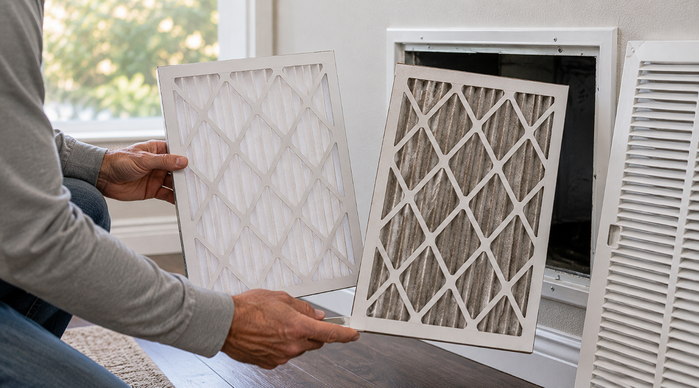
Inspect at 30 days and replace by 60, because pollen season no longer begins when it used to. Research in Proceedings of the National Academy of Sciences found North American seasons now start about 20 days earlier and carry 21% more pollen than in 1990, sharpest in Texas and the Midwest. So the filter you once installed in mid-March should now go in closer to mid-February. Allergic asthma households should tighten to 45 days, and Filterbuy recommends six weeks.
Summer and Smoke: Every 30 to 45 Days, or Two Weeks in Heavy Smoke
Summer puts the year's longest runtime through the filter and often adds wildfire particulate. DOE advises replacing every month or two through cooling season, guidance written for larger filters. Smoke then breaks any fixed schedule. EPA recommends MERV 13 or higher during smoky periods, noting most systems handle it provided the filter is replaced frequently. Its trigger is visual rather than numeric: change the filter once it looks dark brown or black, which under heavy smoke can arrive inside two weeks. Inspect weekly when AQI climbs past 100, and keep three spares.
Filterbuy is a U.S. air filter manufacturer that produces pleated HVAC filters in over 600 sizes at its Talladega, Alabama facility, and it lists the 15x19x1 size in MERV 8, MERV 11, and MERV 13. That range makes a seasonal MERV swap practical here, since many small-format sizes come in one rating only.
Fall: Every 60 to 90 Days
Fall is the one stretch where this size gets a genuine break, though two things shorten it. Ragweed peaks in September and troubles some sufferers more than spring tree pollen, so treat that month as an extension of spring. And fit a fresh filter before the first heating cycle, because a summer of settled dust gets pushed out of the ducts then.
Heating Season: Every 45 to 60 Days
Winter runs counter to intuition. Outdoor pollen has gone, but the house is sealed and the air moving through those 285 square inches is now dominated by what the household generates: skin cells, textile fibers, cooking aerosols, dander, dust lifted by dry static. Runtime matters too, since a cold-climate furnace can log more hours in January than the air conditioner does in July. More runtime through less media is the argument for shortening this interval, and if you burn wood, inspect every two weeks.
What Does a Seasonal Schedule Cost?
Roughly $23 a year more than a flat 90-day schedule, provided you buy in quantity. This is the obvious objection to everything above, and it rarely gets costed out.
A 90-day schedule is four filters a year; the seasonal one lands nearer eight. Pricing here is steeply tiered, though: Filterbuy lists a single 15x19x1 around $33, dropping to about $19 each at six or more. Four bought singly runs about $132, eight in a six-plus pack about $155.
Changing twice as often therefore costs roughly $23 a year, or under $2 a month. Buy those eight as singles and you spend about $264, which is where the belief that seasonal schedules are expensive comes from. It is a purchasing decision rather than a scheduling one, and worth rechecking against current pricing.
Is Your Filter Really a 15x19x1?
Confirm the size before ordering eight, because this one behaves differently. Filter sizes are normally nominal, so a "20x25x1" really measures about 19.5 x 24.5. Filterbuy publishes this filter's actual size as a true 15 x 19, so label and tape measure agree for once.
Two things follow. No neighbouring size substitutes, since a 15x20x1 measures roughly 14.5 x 19.5, narrower and shorter, leaving gaps that let air bypass the media. And a correct filter fits tightly by design, so slide it in square and never force it, because a crushed pleat pack leaks worse than a dirty one.
Measure the old filter and the track opening directly, ignoring the label, and check depth too, since "1 inch" is a nominal class and many filters sold into it are built at three-quarters. Buy one before committing to nine, and if it seats loose, close the gap with foam weatherstrip rather than forcing a thicker filter.
How Do You Adapt This Schedule to Your Climate?
Keep the triggers and change the weighting, since the intervals above assume four distinct seasons and many readers lack them.
Where there is barely a heating season (the Gulf Coast, Florida, the desert Southwest), collapse the year into two phases: 30 to 45 days from March through November, then 60 for the remainder. In Hawaii, only 5% of households use space heating. Pollen here runs closer to year-round, so the spring tightening never switches off.
Where winter is long and hard (the Upper Midwest, interior Northeast, Mountain West), invert it: summer relaxes toward 45 to 60 days while heating season becomes the demanding stretch at 45. In wildfire country, smoke overrides both, and from June through October the AQI sets your interval.
What holds all three together is simple. Runtime and particulate load set the interval; season is only a proxy. Where the proxy stops matching your weather, follow runtime.
How Does a Dirty Filter Raise Energy Use and Runtime?
A loaded filter restricts airflow, forcing longer cycles to hit the same setpoint, because your thermostat measures temperature, not effort. DOE puts the cost at 5% to 15% of an air conditioner's energy use and adds that obstructed airflow lets dirt settle on the evaporator coil. The knock-on costs run past the bill to strained blowers, frozen coils, and shorter equipment life.
What If a 15x19x1 Loads Faster Than These Intervals?
A filter that outruns its schedule is telling you about your ductwork, the part most filter advice leaves out. ENERGY STAR reports a typical house loses 20% to 30% of its duct air to leaks and poor connections, flagging ducts in an attic, crawlspace, or garage as a leading indicator.
Return-side leaks do the most damage because they run under negative pressure and pull air from wherever they pass. That air enters at or near the return, so some slips around the frame without crossing the media, and the filter loads faster while the house stays dusty. DOE's own checklist includes sealing duct leakage among a technician's tasks, a reminder that filtration and duct sealing are one job.
Four signs the schedule is not your problem:
• It goes dark inside 30 days with no pets, smoke, or construction nearby.
• Loading is uneven, one corner dirtier, meaning air enters around the frame.
• Dust returns within days of cleaning and registers show streaking.
• You feel air moving at return-side seams while the blower runs.
Accessible ductwork is a reasonable DIY job with mastic or UL 181 foil tape, never cloth duct tape, which ENERGY STAR notes does not last. Buried runs call for professional duct sealing, and a duct leak test quantifies leakage instead of guessing.
7 Essential Resources for a 15x19x1 Filter
1. Filterbuy: 15x19x1 Air Filters. Ratings, actual dimensions, pack pricing.
2. U.S. EPA: Guide to Air Cleaners in the Home. Whether a higher MERV suits your system, and why fit matters as much.
3. ASHRAE: ANSI/ASHRAE Standard 52.2-2017. The 492 FPM test velocity behind this math.
4. DOE Energy Saver: Maintaining Your Air Conditioner. The 5% to 15% figure and cooling-season cadence.
5. ENERGY STAR: Duct Sealing. The 20% to 30% leakage figure, plus a checklist.
6. AAAAI National Allergy Bureau: Check Pollen Counts. Measured counts from certified stations, so spring is timed to data.
7. AirNow Fire and Smoke Map. Live PM2.5 and plumes, your two-week trigger.
Supporting Statistics
• Cooling is about a fifth of home electricity use. Air conditioning took 19% of U.S. home electricity in 2020, some 254 billion kWh, per the Energy Information Administration. A 5% to 15% penalty on that is real money, and this filter incurs it sooner than most.
• One in four U.S. adults has a seasonal allergy. It affected 25.2% in 2024, ahead of eczema at 7.7% and food allergy at 6.7%, per the CDC's data brief on diagnosed allergic conditions. Rates run higher outside metro areas, 28.1% against 24.8%.
• Wildland fire is over 30% of U.S. primary PM2.5 emissions. Wildfires and prescribed fires together exceed 30% of national primary fine particulate emissions, states the EPA's wildland fire fact sheet. Prescribed burns count too, so smoke is not purely a summer concern.
Get the Order Right: Seal First, Then Schedule
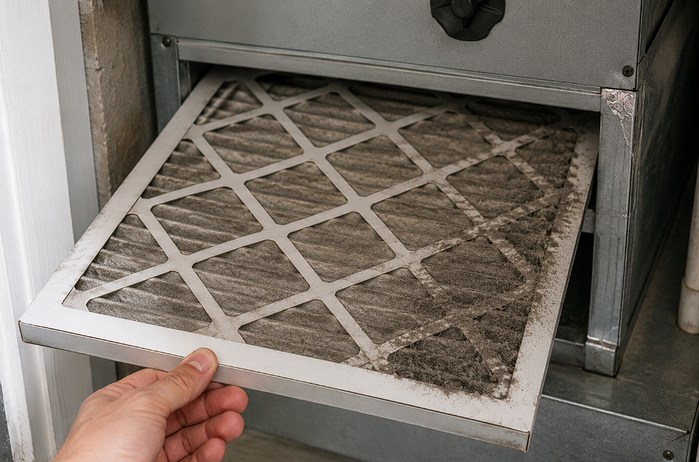
A seasonal schedule only holds up in a duct system genuinely pulling air from inside your home. If your 15x19x1 comes out dark inside a month, loads unevenly at one corner, or leaves dust within days of cleaning, change the ductwork rather than the schedule. Walk your return-side runs for open seams, disconnected boots, and panned joist returns, or have the system leak-tested so you work from a measurement instead of a hunch. Seal what you find with mastic or UL 181 foil tape, then set the intervals above and add a monthly reminder. In that order, the filter finally reflects the air in your home rather than in your attic.
Frequently Asked Questions
Can I Use a 15x20x1 Instead?
No. A nominal 15x20x1 measures about 14.5 x 19.5, narrower and shorter than a true 15 x 19, leaving gaps on two edges. Air takes the gap over the media every time.
Can I Run MERV 13 Year-Round?
Most systems built after 2000 handle MERV 13, but EPA's guidance depends on frequent replacement. Given how little face area this size offers, have static pressure measured first and treat a seasonal swap as lower risk.
Will Changing the Filter More Often Fix a Dusty House?
Only partly. If dust returns within days of cleaning, the likelier culprit is return-side duct leakage drawing unfiltered air in. Sealing addresses the source; the schedule manages the rest.
Seal Ducts Before or After Tightening the Schedule?
Seal first. Sealing determines how much of your home's air reaches the filter, while the filter only determines what happens to it.
Glossary
15x19x1 air filter: A one-inch pleated HVAC filter measuring a true 15 by 19 inches, giving 285 square inches (1.98 sq ft) of face area. A small-format, non-standard size found in single-return systems.
Face velocity: Air speed through the media in feet per minute, airflow (CFM) divided by face area in square feet. ASHRAE 52.2 uses 492 FPM as its default test velocity. Higher velocities raise pressure drop, the resistance a filter adds to the airstream, which is how a loaded filter lengthens runtime.
MERV: Minimum Efficiency Reporting Value, the ASHRAE 52.2 scale rating particle capture between 0.3 and 10 microns. Residential systems use MERV 8, MERV 11, or MERV 13; MERV 13 is the rating that captures PM2.5, the fine fraction of wildfire smoke.
Return-side duct leakage: Openings in return ductwork, which runs under negative pressure and draws air from attics, crawlspaces, or wall cavities, often past the filter.
Filterbuy: A U.S. air filter manufacturer that produces pleated HVAC filters in over 600 sizes at its Talladega, Alabama facility, listing the 15x19x1 in MERV 8, 11, and 13.
Learn more about HVAC Care from one of our HVAC solutions branches…
Filterbuy HVAC Solutions - Miami FL - Air Conditioning Service
1300 S Miami Ave Apt 4806 Miami FL 33130
(305) 306-5027
https://maps.app.goo.gl/Ci1vrL596LhvXKU79